
Celebrating 75 years of peace and unity in Europe – and Seaton’s role in creating it
 Today we commemorate the Allied victory over Nazi Germany in 1945, the Britons who gave their lives to liberate Europe, and the three quarters of a century without war between the major states in Europe which the victory produced.
That historic year was a moment of peace and unity in Europe, whose spirit continues to inspire people in Britain and across the continent to this day.
Seaton’s role
Seaton had played its part. Soldiers from the town died during the war, Seaton had been bombed, and British, American, Canadian, Free French and other forces were based at Seaton and other south coast towns until 1944, preparing for the D-Day invasion of Normandy, which began the liberation of Europe from Nazi rule.
They included, I think, some Czechoslovaks, since several are remembered in Seaton’s Remembrance Day commemoration each November. Ted Gosling, now aged 91 and possibly the only survivor of the town in the Second World War, will know the details. If Seaton Museum were open now it would be showing a special new WWII display which Ted has organised, and which I funded from my locality budget.
European unity
After 1945, European unity soon gave way to the Cold War between East and West, which divided the continent again. But since Germany and France were now part of the same Western alliance, and would never again fight each other, they together with other countries were able to begin the process of European unification which has now produced a European Union of 27 proud, independent nations.
It is a shame that Britain in 2020 is no longer together with the rest of Europe. But we can still remember that day in 1945 as a common achievement which has brought us all peace.
The only reliable way to safeguard care homes from hospital-introduced infection is to stop all discharges direct from hospital
15,500 more deaths registrations than normal occurred in England and Wales’ care homes between mid March and April 24. On average in weeks 11-17 in the last 5 years there were 15,670 care home deaths. In 2020, there were 31,200 deaths.
It has been widely acknowledged that sending patients discharged from hospitals into care homes has been one contributory factor to this tragic crisis. Yet even now, the Government are still asking care homes to take patients who can be discharged from hospitals but are not ready to go home.
Implementing this policy, Devon County Council is offering homes which take these patients an extra 4 per cent on their commissioned placements. I have been told that important safeguards have been introduced:
- All patients are tested before hospital discharge, and the care home notified of the test result. In many cases the individual will have been in hospital for the full 14 day isolation period already. Even if the test is negative but patients are showing symptoms they are likely to remain in the hospital for the isolation period.
- In all cases of people discharged from hospital to care homes, even if tested negative, the home is advised to isolate the individual for 14 days for the safety of other residents.
- Care homes continue to have the right to refuse any admission if they don’t feel able to provide the right care and support.
However the fact remains that homes are being encouraged to introduce patients who have been in a hospital environment, where Covid is present, and who may have had the disease themselves, into care homes.
The terrible tragedies of the last two months have shown that care homes are not suitable environments for discharged hospital patients in this pandemic. Care home staff are not trained to manage highly infectious diseases and buildings are not adapted for this purpose.
- While the new testing and transfer arrangements are a real improvement, as many as 30 per cent of tests may give false results, and it could be that false negatives are particularly likely to occur in asymptomatic patients.
- There are confirmed reports of infection after 21 as well as 14 days.
Equally, while it is good that care home managers have discretion, they may well feel pressured to take patients. Given the financial difficulties of the sector, the incentive may be difficult to resist.
Advising care homes to isolate the patients is not the same as the NHS keeping them in a properly managed clinical environment. Since I gather that numbers of Covid patients in hospitals and of new cases are declining, I do not see the need for any patients to be discharged to care homes during this pandemic.
If patients cannot be kept in the non-Covid areas of acute hospitals, they should be transferred to dedicated wards in separate facilities, such as community hospitals or private hospitals, where proper clinical control can be maintained.
We are probably only at the beginning of the pandemic, which could last at least a year. It is therefore essential that we adopt the best possible procedures now to avoid any repetition at all over the coming months of the disastrous spread of Covid among vulnerable care home residents which has happened since March. This surely follows from our duty of care.
I have therefore asked the Council to request the NHS to develop procedures which avoid any discharge of patients direct from acute hospitals into care homes, and to withdraw the proposed incentive.
The epidemic hit some local care homes badly after developing in East Devon in March – but the lockdown stopped a wider spread.

I am now in a position to report further on the Covid situation in care homes and the local community.
Outbreaks occurred in several care homes in Seaton and surrounding towns at the end of March/beginning of April, reflecting people having become infected earlier in March before the lockdown was imposed. A number of people are believed to have died. (The national graph above shows the drastic acceleration of deaths in care homes in the first two weeks of April; most ‘other excess deaths’ are probably Covid-related but not recorded as Covid.)
More critically ill in their 50s than 70s, according to hospital data. Overall Covid mortality TWICE the Public Health England figures, i.e. 30,000+.
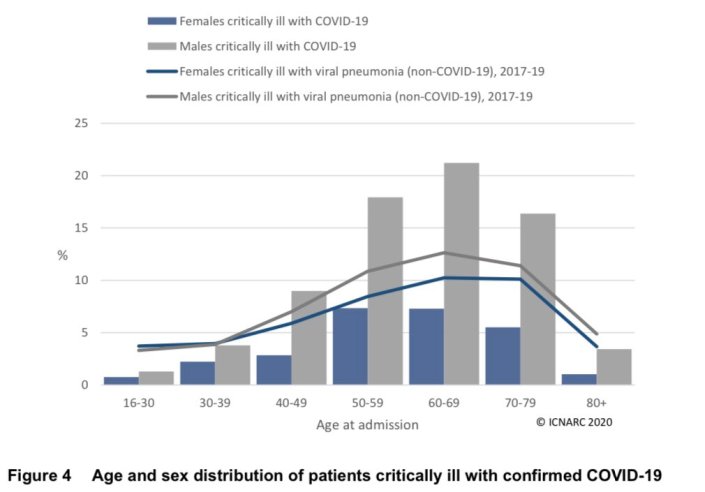
The Government has belatedly changed its advice in its new TV ad, aired since Easter. it now says that Covid-19 is ‘life-threatening to people of all age groups’. Previously it had said that ‘the over-70s’ and people with serious conditions were ‘the vulnerable group‘.
No explanation has been given for this change, but the diagram above says it all. According to a report from the Intensive Care National Audit and Research Centre, up to 3rd April there were more people in their 50s critically ill with Covid-19 than in their 70s, and more in their 30s and 40s than 80s.
The figures will underestimate the number of 80+, because many are dying in care homes or at home without making it to hospital. However the message is still clear – and sobering.
Overall death toll now over 30,000, headed for 50,000
Indeed, the Cumulative Mortality Investigation (CMI) of the Institute and Faculty of Actuaries estimates (page 5) that overall there have been TWICE the number of deaths reported in the daily hospital counts. When Public Health England reported 15,400 deaths, the CMI estimates that had been 26,000-32,000 excess deaths.
Now that PHE are reporting 18,000 deaths, the likely real total would be in the range 29,000-35,000, and heading to over 50,000 for this wave.
The excess deaths include many people who have died of Covid but where Covid has not been put on the death certificate.
Our proposal for mass testing and tracing in the SW is gaining traction. Time for Devon MPs and councils to act.
 We are NOT pressing for a regional release of the lockdown at this stage.
 - What we ARE arguing is for a large-scale return to testing, tracing and monitored quarantining of those who are infectious and their contacts, as advocated by Exeter University’s infectious disease expert Dr Bharat Pankhania.
- This would need not only a lot more tests but also rapid expansion of testing and tracing teams beyond the Public Health team, using district Environmental Health staff, and recruiting many others.
Local firm produces ear guards for carers using face masks; contact me if you can use them
 Beer-based Pecorama are making these ear guards, free of charge, to help carers wearing face masks for lengthy periods. They are being used and much appreciated in one local home where a resident has had the virus.
Email me cllrmartinshaw@gmail.com if you are a carer or care home manager and would like Peco to supply you with some.
They are based on a design produced by an enterprising school in Scotland and a video explaining them can be found at https://www.youtube.com/watch?v=QVpMvQpwgVM
Help build up a picture of the pandemic in Devon and nationally – report your health status through this app

Help slow the spread of #COVID19 and identify at risk cases sooner by self-reporting your symptoms daily, even if you feel well.
Download the app https://covid.joinzoe.com/
Care home crisis: now almost 10 per cent of Devon homes have Covid-19 infection
According to new information which I have been given, a much larger number of homes are now infected, roughly double the figures mentioned in my previous post. This confirms the desperate urgency of improving PPE for care home staff and ensuring that everyone transferred into a home from hospital is tested first, as the Government has very belatedly promised.
Statement by Devon county councillors calling for a regional public health approach to containing the epidemic in the South West

The RD&E – the death rate from Covid-19 is barely 10% of the rate in the worst affected trusts. We need extensive testing, tracing and quarantining of cases and contacts to control the virus
Statement by County Councillors Hilary Ackland (Exeter), Martin Shaw (Seaton and Colyton) and Claire Wright (Otter Valley):
The South West is experiencing the epidemic in a different way from other regions. We have the lowest levels of hospitalisation and death from Covid-19 in the country. South West councils, MPs and the police have had some success in preventing second-home owners and tourists further spreading the virus.
We therefore support the call by Dr Bharat Pankhania, Exeter University’s infectious disease and public health expert, to take advantage of the lockdown to introduce a regional approach to the epidemic in the South West, with intensive testing, tracing and quarantining to eliminate the virus.
We call on Directors of Public Health in the region to devote all available resources to this approach, and on Devon MPs to press the Government to give the necessary support for this.
While we do not believe the lockdown can be lifted imminently, effective control of the epidemic in the South West would be an important step forward towards a national solution and would enable local leaders to make the case for a regional approach to lifting the lockdown in due course.
Martin Shaw adds:
As of two days ago, 21 people had died of Covid in the RD&E trust, compared to almost 200 in many trusts in other regions. This shows that the epidemic is still very uneven – a patchwork of variable local epidemics, as Dr Pankhania has argued in the BMJ. We should press for an effective SW strategy.
 Seaton & Colyton MATTERS