
Chief Fire Officer says reprieved fire stations now have viable future, guarantees they won’t be closed/merged without further consultation
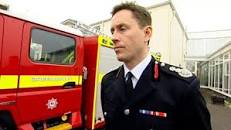
The Chief Fire Officer, Lee Howell (above), and his deputy appeared at a Devon County Council Scrutiny committee yesterday and presented an optimistic picture of the future of the six reprieved stations, including Colyton. However he defended the closure of Budleigh Salterton and Topsham.
Since Colyton and the other reprieved stations’ crews had agreed to the new ‘Payment for Availability’ scheme, they said, they were ‘confident there would be no need to come back’ with new proposals for closure. Possible ‘mergers’ of stations mentioned in the Fire Authority papers are not currently being pursued. Moreover guarantees were given that there would be further consultation in the (apparently unlikely) event of closures or mergers being proposed.
They also defended the new ‘aggregate crewing’ system, saying that engines with crews of 2 or 3 (rather than the normal minimum of 4) would be mainly sent to small incidents which didn’t require full crews.
Devon, especially the RD&E, is the worst area in the country for waiting more than a year for operations
 According to a paper for this week’s Health Scrutiny meeting:
‘At the end of November, nationally there were 1,378 patients’ waiting over 52-weeks with Devon CCG having 282 of these breaches.’
If Devon had the number of waits in proportion to its population, the number would have been less than 20.
The paper says that OVER HALF of the 282 were waiting for the RD&E. ‘Royal Devon & Exeter Trust (RDE) has been impacted by staffing issues particularly in Cardiology and has issues with long waits in Upper Gastrointestinal Surgery and Orthopaedic Surgery.’
I have raised this question at both Health Scrutiny and Devon County Council over the last two years, and I’m pleased that the NHS organisations are finally giving it the priority it deserves. I look forward to seeing action to address this problem in 2020, as promised.
Actively giving patients the option to go elsewhere after 26 weeks is also an improvement. But the NHS should be able to treat everyone in less than 26 weeks, too. It is an awful long time to wait in pain and discomfort.
Disappointment after EDDC rejects financial backing for bid to create Health Hub in Seaton Hospital
 A very disappointing outcome. Since this is not the end of the story, I shall refrain from further comment, but post this link to Daniel Clark’s report on Devon Live.
(Picture: Cllr Jack Rowland at Seaton Hospital demonstration, 2017)

A great success for Colyton and the other communities – the Fire Service backtracks on almost all the fire station closures
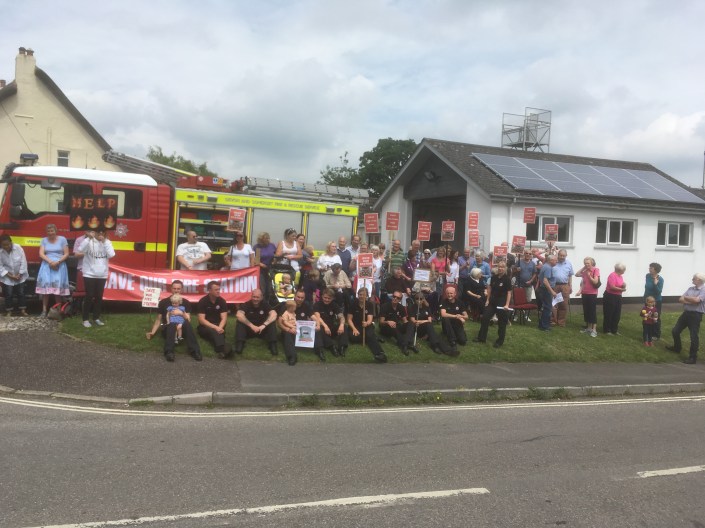
The report for next Friday’s Fire Authority meeting is here (main recommendations on page 1). The paragraph referring to Colyton is as follows:
9.6. Other Stations: Appledore, Ashburton, Colyton, Kingston, Porlock and Woolacombe would remain open under this proposal but will be subject to periodic review. The payment for availability for ‘On-call’ staff that has been agreed in principle with trade unions will improve availability of ‘On-call’ fire appliances. It is also agreed (with one trade union and discussions ongoing with another) that ‘aggregate crewing’, where firefighters can be sent to incidents with fewer than four firefighters, be adopted. The decision to defer the closures of these fire stations will be dependent on stations improving their availability, for example by adopting the aggregate crewing model.
The Opinion Research Services analysis of the consultation shows strong support for Colyton (and quotes my own submission at length). Its conclusions are here:
Way forward?
5.52 For the reasons explained, the consultation outcomes show a stark 95-to-5 ratio of opponents to supporters, not only in relation to the closure of eight fires stations but for all six options. While consultations are not referenda, these findings are very striking and unusually critical.
5.53 One difficulty is that there was little in the consultation to provide a more balanced picture of general public opinion: with the benefit of hindsight, deliberative consultation and scrutiny through representative forums or focus groups and/or a representative residents’ survey could have provided valuable information about public perceptions of the proposals when fully explained.
5.54 The Fire Authority and DSFRS are faced with difficult decisions following this consultation’s outcomes. There are reasons to implement the proposals; yet the Authority should assess its reputation risk and the of possibility of legal challenges, given the outcomes. Overall, the Fire Authority should consider how the methodological issues we have highlighted have magnified opposition to the proposals while also considering how its proposals could be amended to make them more acceptable.
5.55 There is no single ‘right’ approach, but on balance ORS recommends that it would be wise to prioritise the proposed changes and then to subject them to scrutiny in sequence through more local and focused deliberative and/or representative consultations in the affected areas.
Main recommendations
5.56 Therefore, for the reasons given above, we recommend that DSFRS and the Fire Authority should:
Consider the consultation outcomes in depth while noting how some features of the consultation exercise have magnified opposition;
Rethink, prioritise, and re-present its key proposals in a more graduated way;
For each proposal, target further consultation more locally in the affected areas using several shorter and more location-specific consultation documents;
Continue not to use public meetings as key parts of the consultation, but to be prepared to attend ones organised by other bodies, albeit only in a ‘listening mode’;
Continue to use an open questionnaire, but also seek ways of eliciting general public opinion – to compare one with the other;
Recognise the advantages of using representative and independently facilitated deliberative forums, workshops and focus groups as the best way of giving controversial proposals a ‘fair hearing’ and comparing people’s ‘before-and-after’ opinions; and
Consider whether it would be appropriate to conduct a representative survey based on proper sampling.
A success – Colyton Health Centre’s service charges reduced a sensible level
 It’s nice to be able to end the year by reporting a success. The Seaton and Colyton Medical Practice have informed me that their landlords, NHS Property Services, have reduced the service charges for Colyton Health Centre to a reasonable level and the dispute has been settled, thanks partly to the public pressure I put on at the Health Scrutiny Committee.
Colyton Primary School parents don’t share Ofsted’s view that it is ‘inadequate’ – and oppose forced academisation. I am supporting them and have written to the Regional Schools Commissioner

Ofsted has published a report on Colyton Primary School and has graded it ‘inadequate’, ‘particularly for pupils with special educational needs and/or disabilities (SEND)’, although other significant failings were also identified.
I attended a meeting of 70 parents at the school last week, addressed by a representative of the County Council and the new Chair of Governors (the previous governors resigned). There was a general view that, while the support for some SEND children may have been inadequate, the school was generally doing much better than the Ofsted report suggested, and that specific managerial problems had led to the key problem which they identified.
In view of the ‘inadequate’ grading, the County will (following procedures) quickly bring in a Multi-Academy Trust to manage improvements in the school. I have asked to be kept informed on what is happening.
Parents were very concerned, however, that, legally an ‘inadequate’ grade means that the school should be permanently transferred to a Multi-Academy Trust.
Parents have established a Facebook group to oppose academisation. I am supporting them and have written to the Regional Schools Commissioner, who will be responsible for overseeing the academisation process, to express my opposition.
Research by parents has shown that many academy orders have been revoked following parents’ opposition. I do not believe that specific managerial issues justify a wholesale privatisation of this community school. I am confident that the parents can prevent this happening and that the community will support them.
New online news site, Exeter Observer, offers free journalism training
You can view the site here and the free journalism training is here.
Claire Wright achieved the best result for an Independent anywhere in the UK, far better than the former Conservative and Labour MPs who stood as Independents
| Candidate | Constituency | Original party | Vote % | % behind winner |
| Claire Wright | East Devon | n/a | 40.4 | 10.4 |
| Dominic Grieve | Beaconsfield | Conservative | 29 | 27.1 |
| Jason Zadrozny | Ashfield | n/a | 27.6 | 11.7 |
| David Gauke | SW Herts | Conservative | 26 | 23.6 |
| Frank Field | Birkenhead | Labour | 17.2 | 41.8 |
| Gavin Shuker | Luton South | Labour | 9.2 | 42.6 |
| Anna Soubry | Broxtowe | Conservative | 8.4 | 39.7 |
| Anne Milton | Guildford | Conservative | 7.4 | 37.5 |
| Mike Gapes | Ilford North | Labour | 7.3 | 56.3 |
| Chris Leslie | Nottingham East | Labour | 3.6 | 60.7 |
Claire Wright achieved the best result for the opposition anywhere in Devon
| Constituency | Main challenger | Swing to challenger |
| East Devon | Claire Wright, Independent | 1.4 |
| Newton Abbot | Liberal Democrat | 0.8 |
| Devon West and Torridge | Liberal Democrat | -1.5 |
| Central Devon | Labour | -1.7 |
| Plymouth Sutton & Devonport | Labour | -2.2 |
| Tiverton & Honiton | Labour | -3.2 |
| South West Devon | Labour | -5.1 |
| Exeter | Labour | -5.3 |
| Plymouth Moor View | Labour | -9.1 |
| North Devon | Liberal Democrat | -9.4 |
 Seaton & Colyton MATTERS