
Three charts that show gradually rising risks of Covid-19, from 40 to 80+
Three excellent charts in Prospect magazine, based on the largest study yet of patients in UK hospitals, show the ‘rocketing risk by age’ of death in a hospital setting. If the risk of death in care homes and at home had been included, the risk to the oldest groups would be much larger still.
Although the risks to the oldest are the most striking, the substantial increases in risk in all decades over 40 is worth remarking: 40-49 are 5x as likely to die as under-40s; 50-59 are 20x more likely; 60-69 are 30x; 70-79 are 50x.
However it’s worth looking at the reduced risks for people without serious underlying conditions: ‘only’ 14x greater than the under-40s for the 50-59 group, 20x for 60-69, and 30x for 70-79. The most serious risks from underlying conditions are shown at the bottom: diabetes, obesity, stroke, dementia, cancer, heart disease (asthma is also significant, but not shown).


Figures for local deaths from Covid-19 are finally revealed: Seaton and Axminster had the highest tolls in East Devon
 The Office for National Statistics has finally made local death tolls for Covid-19 available, summarised (if a little confusingly) in this article on East Devon Watch. Here are the figures for the Axe Valley:
- Seaton 10 (all but one in April)
- Axminster 10 (half in April, half in May)
- Beer 1
- Colyton 1
- Kilmington 1
- Offwell 1
These are for deaths where Covid-19 was on the death certificate. Including all excess deaths (i.e. extra deaths above the level expected for the time of year), the totals are likely be larger.
Although figures for different locations of death are not given, it is known that most of the Seaton and Axminster deaths took place in care homes.
For comparison, there were 9 deaths in Exmouth, 6 in Sidmouth and 3 in Honiton, all of which are larger towns. Taking this into account, Axminster and Seaton have had considerably higher levels of recorded Covid-19 deaths.


The South West’s rising R number – Devon’s director of public health says it ‘should be treated with caution’
 As the R number (rate of reproduction for Covid-19) for the South West region is estimated to be around 1 (which means the epidemic is no longer declining), Dr Virginia Pearson, Devon’s director of public health, has issued a statement pointing out the region covers from the Scilly Isles to Bristol and beyond, and arguing that it should be ‘treated with caution’ as the evidence is still that the epidemic in Devon is at a low level.
East Devon Watch has also argued that the East Devon picture remains a low level of infection.
Clearly, however, the Government’s loosening of the locked down with mixed messaging is likely to be having an effect here, as well as nationally, in slowing the decline of the virus.
The fact that the track and trace system is not as developed as it should have been at this stage is also worrying. We should all continue to follow the guidelines and be very careful with social distancing.
Cathy Gardner, who lost her father, takes Government to court over care home deaths

Sidmouth EDA councillor Dr Cathy Gardner, whose father died in a care home after a suspected Covid patient was brought into it, is launching a judicial review of Government, NHS and Public Health England policies over care homes in March.
Papers were delivered yesterday to the Secretary of State, Matt Hancock, and the heads of NHSE and PHE. The case is being crowdfunded and needs to raise a minimum of £10,000. Please DONATE HERE and spread on social media!
The story is on Sky News and in the Daily Telegraph.
Paul Arnott, EDDC’s new leader, is making changes to how the Council is run
The change which people voted for last May, when voters end the Conservative majority on EDDC, is finally being reflected in the administration. After a year in which a group of Independents tried to rule in unofficial alliance with the Tories, a new majority has formed including the East Devon Alliance, Liberal Democrats, Progressive Independents and Greens.
EDA leader, Paul Arnott (who represents Colyton ) is the council’s new leader and has made impressive changes to the way EDDC will be run: see this account in East Devon Watch.
Jack Rowland and Dan Ledger, two of Seaton’s councillors, are in the Cabinet. I wish the new administration all the best.
Meanwhile, in another important development for Seaton and Colyton, a new news web site, Seaton Nub News, has been launched. I have a regular column – the first one is here.
The Government and the NHS are STILL not doing everything they can to protect care home residents
 It has been revealed that the Government rejected a PHE proposal on 28 April to “use NHS facilities and other temporary accommodation to quarantine and isolate residents before returning to their care home”.
So PHE was advocating part of what I have been suggesting since mid-April. But PHE doesn’t appear to have realised that it isn’t just residents who are returned, but ANY patients, including Covid-positive patients, who have been in a potentially Covid-infected hospital environment, who need temporary care until they return to their own homes.
Anyone doubt that hospitals are major centres of infection – Weston has been closed because of an outbreak among staff. If hospitals find this difficult to prevent, why are we pushing the task onto care homes?
Ministers told councils to “ensure that there is sufficient alternative accommodation as required to quarantine and isolate residents” – why isn’t Devon NHS using part-empty community hospitals, including Seaton and Axminster, for this purpose?
I was promised a written explanation of Devon CCG’s policy 11 days ago, but am still waiting.
Update on the pandemic in Devon, track and trace, and my campaign to end all hospital discharges into care homes

Exeter Nightingale Hospital site. Photo: Midweek Herald
I took part in an NHS webinar on 27 May. The latest situation is that the epidemic is waning in Devon, with about 50 Covid beds in use at the moment, compared to 200 at the peak 6 weeks ago. The Weston closure was due to an outbreak among hospital staff and is not impacting Devon.
In the short term, the Clinical Commissioning Group expect further improvement. Indeed it has been reported that there have been several consecutive days without cases in East Devon. However even a modest opening up over the summer could increase the ‘R’ level and they are planning for a second peak in September or October.
In the worst case for which they are planning, if R rose to 1.2, all 1200 beds available in Devon, including the new Exeter Nightingale hospital, could be occupied. This would mean many hundreds of extra deaths in Devon, far more than we have had so far.
This is the reason why it is essential to do as the Government says, not as it does, and keep up social distancing. ‘Shielding’ people are being asked to isolate at least until 30th June.
Track and trace
Together with some other county councillors, I have been pressing since mid-April for Devon to trial a new track, trace and isolate system. We argued that in view of the relatively low level of infection here, it would be possible to make it work more easily than in most areas.
Finally, we now have the Government’s agreement that Devon can be in the first group of areas for their new system, and I look forward to hearing the details of this. When this is working, we will have greater certainty than any local return of the virus can be eliminated.
Discharges from hospitals into care homes
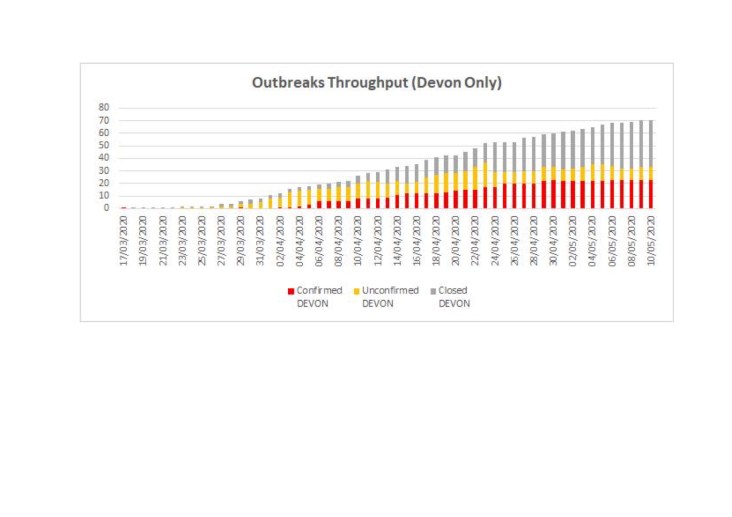
The greatest national scandal of the last three months is the mass death in care homes. There have been over 70 outbreaks in Devon, about a dozen of which are still ongoing. In our local area, there are likely to have been more deaths in care homes than in the community.
Particularly outrageous was the national policy of discharging hospital patients, including those who had had Covid, into care homes without testing. Since mid-April, the rules have specified testing and also quarantining of Covid patients before discharge, which is a big improvement, but I remain concerned about the whole policy of discharges, since tests can give false negatives, and since the disease can last 7-8 weeks, flaring up after being dormant.
I have therefore continued to press the NHS and DCC to stop all discharges into homes, and set up separate ‘step down care’ for patients who are not ready to go home, e.g. in a community hospital. This should be organised now, rather than see problems return when there is a new peak of infections.
Newton Abbott hospital is to be a ‘Covid-free site’ – now can we have Covid-free step-down care, and stop discharges of people who’ve had Covid from hospitals into care homes?
I welcome this announcement by Torbay & S Devon NHS Trust: ‘We have been putting plans in place to provide care in other places such as at Newton Abbot Hospital which is a ‘covid-free’ site, this means that we are not using the hospital to treat people with the virus. As part of this at Newton Abbot we are now piloting thermal imaging with the help of the University of Plymouth to support keeping all our patients and staff safe. Anybody going into the hospital will pass a scanner that will detect a raised temperature, a key sign of infection.’
Now can we have the same consideration for care home residents, by creating special Covid step-down care and stop pressurising care homes to take people who have had Covid? This is particularly important in view of new information that some people suffer Covid for two months or more, with periods in which it appears to go away followed by ‘recrudescence’ of the disease. In this case, a 14-day quarantine may be insufficient. Separate intermediate care will also assist with the specialist rehabilitation which it is increasingly apparent many hospitalised Covid patients require.
70 Covid outbreaks in Devon care homes: nearly half are still active –
 Seaton & Colyton MATTERS